Satellites of the Giant Planets
icy moons of Jupiter and Saturn
The icy moons of Jupiter and Saturn are among the most compelling targets in the search for habitable environments beyond Earth. Our research focuses on understanding the surface composition, thermal properties, and geological processes of these fascinating worlds.
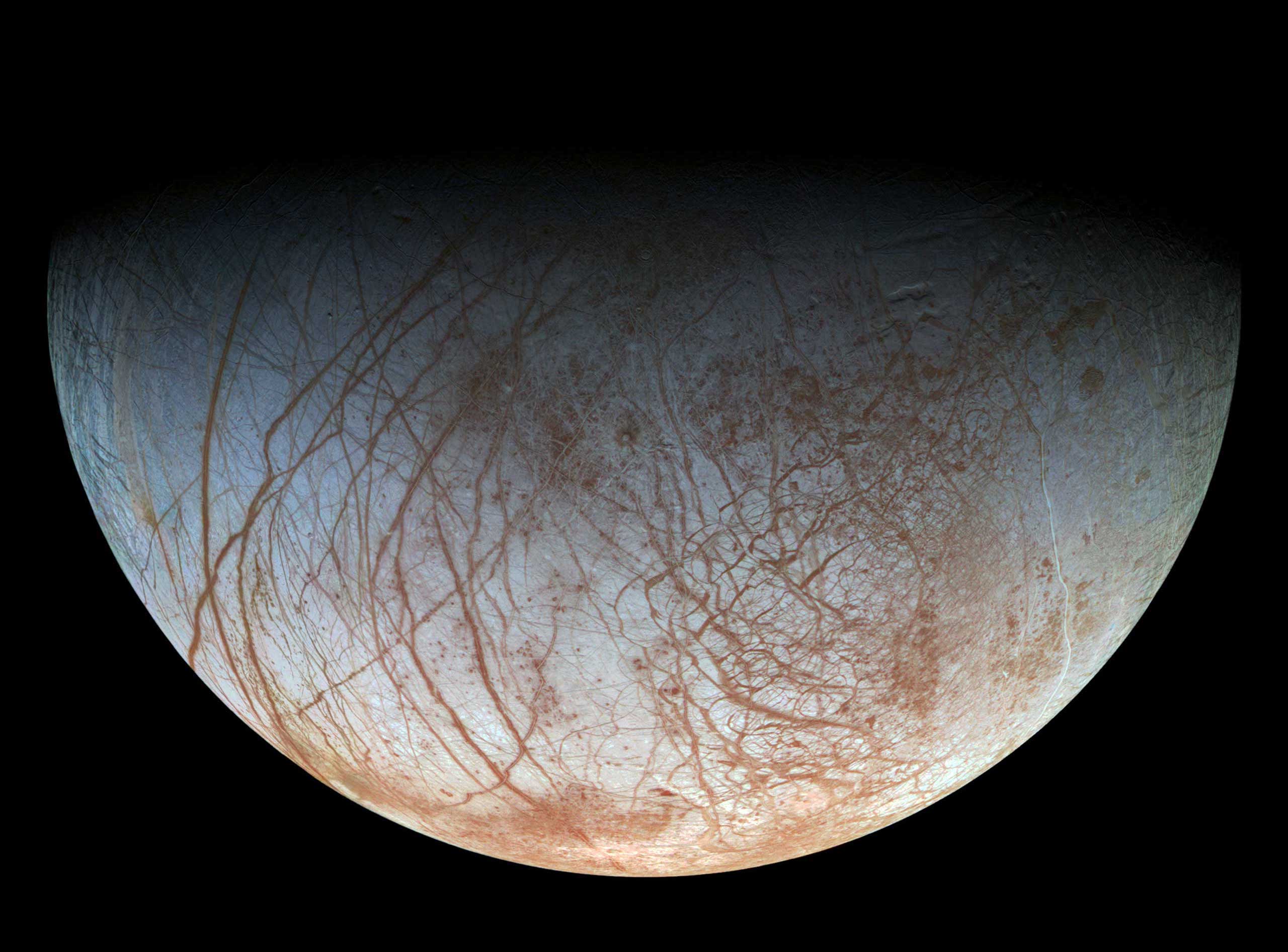
Europa
Jupiter’s moon Europa harbors a global subsurface ocean beneath its icy shell. We study Europa’s surface composition and thermal environment to understand the exchange between the ocean and surface, and to prepare for future exploration missions.
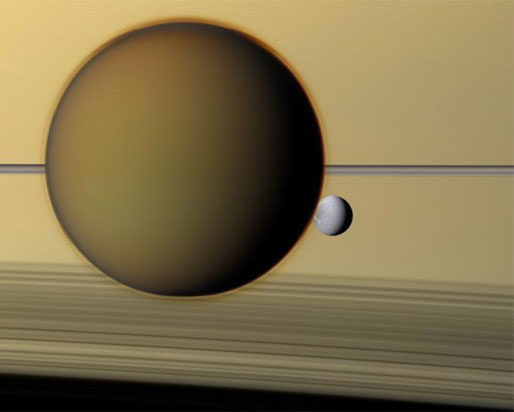
Titan
Saturn’s largest moon Titan has a dense atmosphere and surface lakes of liquid methane and ethane. Our research uses spectroscopic observations to probe Titan’s atmospheric structure and surface composition through solar occultation experiments.
Related Missions
Related Datasets
Related Publications
- Christensen, P. R., Spencer, J. R., Mehall, G. L., ..., Hayne, P. O., et al. (2024). The Europa Thermal Emission Imaging System (E-THEMIS) Investigation for the Europa Clipper Mission. Space Science Reviews, 220, 38. Link
- Daubar, I. J., Hayes, A. G., Collins, G. C., ..., Hayne, P. O., et al. (2024). Planned Geological Investigations of the Europa Clipper Mission. Space Science Reviews, 220, 18. Link
- Burnett, E. R., & Hayne, P. O. (2023). Spin-orbit coupling of Europa's ice shell and interior. Icarus, 406, 115731. Link
- Roberts, J. H., McKinnon, W. B., Elder, C. M., ..., Hayne, P. O., et al. (2023). Exploring the Interior of Europa with the Europa Clipper. Space Science Reviews, 219, 46. Link
- Tomlinson, T. C., & Hayne, P. O. (2022). Composition and possible origins of dark crater ejecta on Europa. Icarus, 385, 115037. Link
- Burnett, E. R., & Hayne, P. O. (2021). Europa's hemispheric color dichotomy as a constraint on non-synchronous rotation. Icarus, 364, 114438. Link
- Mitri, G., Postberg, F., Soderblom, J. M., ..., Hayne, P. O., et al. (2018). Explorer of Enceladus and Titan (E²T): Investigating ocean worlds' evolution and habitability in the solar system. Planetary and Space Science, 155, 73–90. Link
- Bonnefoy, L. E., Hayes, A. G., Hayne, P. O., et al. (2016). Compositional and spatial variations in Titan dune and interdune regions from Cassini VIMS and RADAR. Icarus, 270, 222–237. Link
- Hayne, P. O., McCord, T. B., & Sotin, C. (2014). Titan's surface composition and atmospheric transmission with solar occultation measurements by Cassini VIMS. Icarus, 243, 158–172. Link
- Barnes, J. W., Buratti, B. J., Turtle, E. P., ..., Hayne, P. O., et al. (2013). Precipitation-induced surface brightenings seen on Titan by Cassini VIMS and ISS. Planetary Science, 2, 1. Link
- McCord, T. B., Hansen, G. B., Combe, J.-P., & Hayne, P. O. (2010). Hydrated minerals on Europa's surface: An improved look from the Galileo NIMS investigation. Icarus, 209, 639–650. Link
- Barnes, J. W., ..., Hayne, P. O., et al. (2009). VIMS spectral mapping observations of Titan during the Cassini prime mission. Planetary and Space Science, 57, 1950–1962. Link
- McCord, T. B., Hayne, P., et al. (2008). Titan's surface: Search for spectral diversity and composition using the Cassini VIMS investigation. Icarus, 194, 212–242. Link