Diviner H-parameter
lunar thermal inertia maps
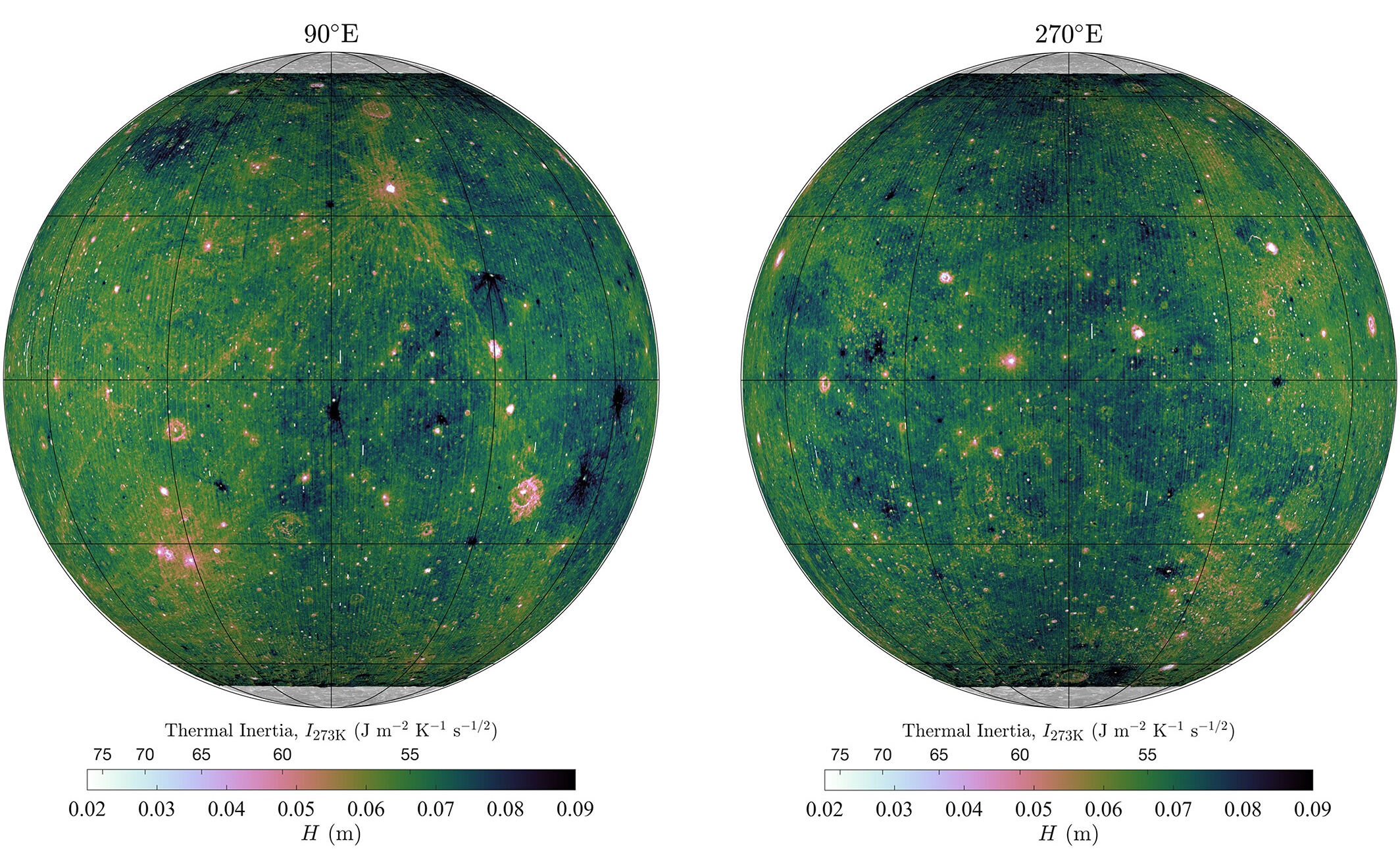
The H-parameter is a measure of subsurface structure derived from Diviner Lunar Radiometer observations aboard the Lunar Reconnaissance Orbiter. These maps characterize the thermophysical properties of the upper few centimeters of the lunar regolith.
Dataset Information
| Property | Value |
|---|---|
| Source | LRO Diviner Lunar Radiometer |
| Coverage | ±70° latitude |
| Resolution | 128 pixels per degree |
| Format | 32-bit floating point |
Dataset Contents
The data directory contains:
- H-parameter maps — Values in meters, representing the e-folding depth scale of the regolith density and conductivity profiles
- Latitude and longitude grids — Corresponding coordinate arrays for georeferencing
- Thermal inertia maps — Derived thermal inertia referenced to 273 K, at 10 pixels per degree resolution
Scientific Background
The H-parameter describes the characteristic length scale over which regolith density and thermal conductivity increase with depth due to compaction. It is the e-folding depth of the exponential density and conductivity profiles in the upper regolith.
Lower H values indicate more rapid densification with depth, corresponding to higher thermal inertia materials such as rocks or consolidated regolith. Higher H values indicate a more gradual density profile, characteristic of fine-grained, porous regolith with lower thermal inertia.
Download
Further information:
- Hayne, P. O., Bandfield, J. L., Siegler, M. A., Vasavada, A. R., Ghent, R. R., Williams, J.-P., Greenhagen, B. T., Aharonson, O., Elder, C. M., Lucey, P. G., & Paige, D. A. (2017). Global regolith thermophysical properties of the Moon from the Diviner Lunar Radiometer Experiment. Journal of Geophysical Research: Planets, 122, 2371–2400. Link
- Vasavada, A. R., Bandfield, J. L., Greenhagen, B. T., Hayne, P. O., Siegler, M. A., Williams, J.-P., & Paige, D. A. (2012). Lunar equatorial surface temperatures and regolith properties from the Diviner Lunar Radiometer Experiment. Journal of Geophysical Research: Planets, 117, E00H18. Link